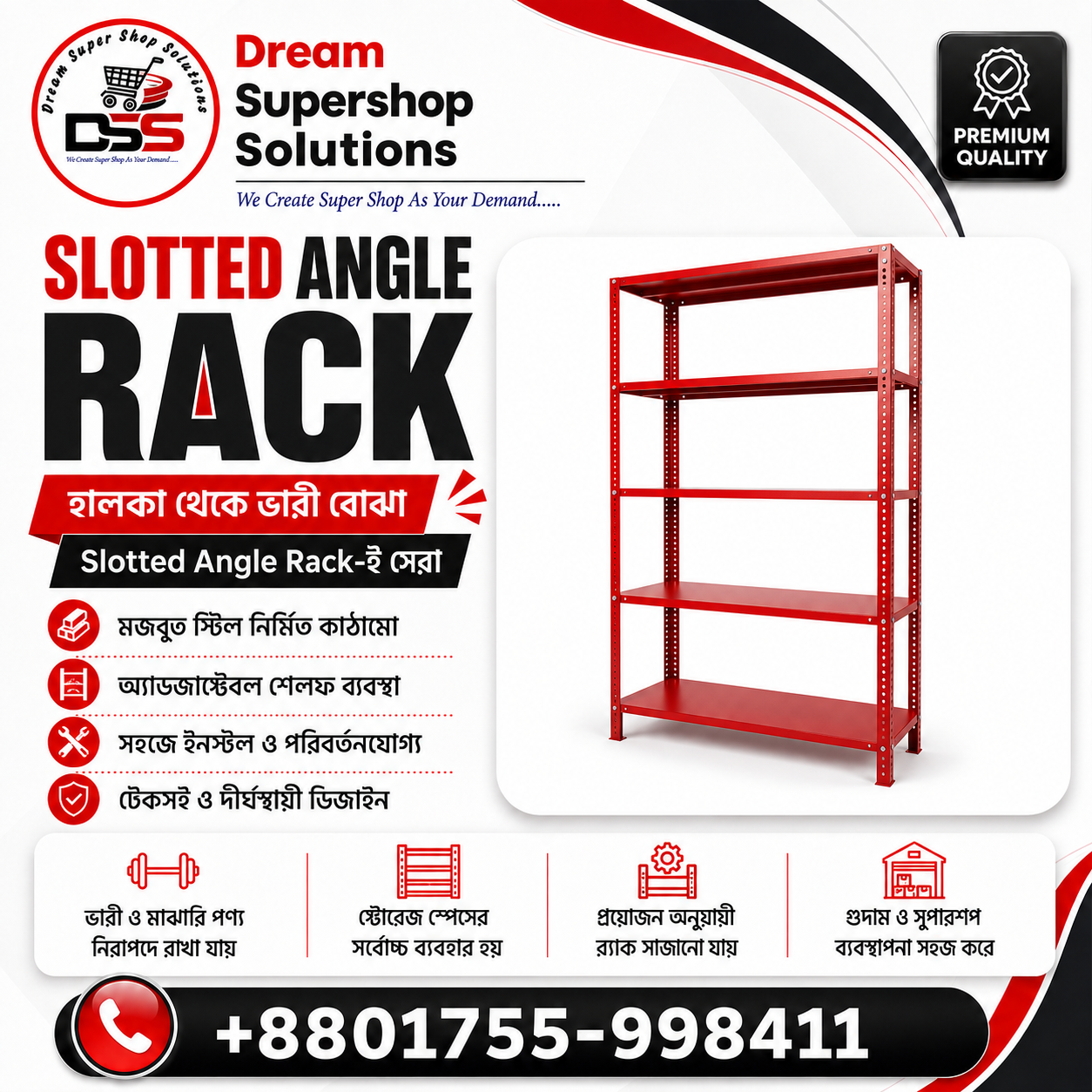
Heavy Duty Industrial Rack Price in Bangladesh
Category:
Total Price : BDT205.00
Heavy Duty Industrial Rack Price in Bangladesh depends on rack dimensions, shelf quantity, steel thickness, bracing, finishing, approved load, and customization. The Heavy Duty Industrial Rack from Dream Super Shop Solutions is professional warehouse equipment for warehouses, industrial stockrooms, factories, workshops, distribution centres, and commercial storage facilities. Its reinforced steel structure, adjustable shelf levels, and multi-tier configuration help businesses organize heavy goods while using vertical space efficiently. Contact Dream Super Shop Solutions for a technically suitable design, customized dimensions, installation support, and project-specific pricing.
Product Specification of Heavy Duty Industrial Rack
Warehouse Rack
Height : 1830 mm
Length: 1600 mm
Width: 1220 mm
Number of Layer: 3 Pcs
Loading Capacity: 600 Kg Per Layer
Sheet profile: Imported Tempered Metal Mild Sheet (Made in Japan)
Description
🏗️ Heavy Duty Industrial Rack Price in Bangladesh
A Heavy Duty Industrial Rack is a reinforced storage system designed to support the organised storage of heavy goods, bulk inventory, equipment, and industrial materials. Its adjustable shelving and durable structural design can help businesses make efficient use of vertical storage space while maintaining convenient access to stored items.
The Heavy Duty Industrial Rack from Dream Supershop Solutions is suitable for factories, industrial stockrooms, workshops, distribution centres, warehouses, and other commercial facilities that require organised storage for heavier inventory.
The Heavy Duty Industrial Rack Price in Bangladesh depends on several factors, including rack height, width, depth, shelf quantity, material thickness, load capacity, structural configuration, bracing, finishing, installation requirements, delivery location, and customisation. Businesses should select a rack based on their actual storage requirements and confirmed technical specifications rather than price alone.
📌 Product Overview
A Heavy Duty Industrial Rack is a reinforced commercial storage system designed for organising heavy goods, bulk inventory, equipment, and industrial materials. It commonly consists of perforated angle uprights, horizontal shelf supports, shelf panels, bolts, braces, base components, and structural connections. Its adjustable slotted frame allows shelf levels to be positioned according to the dimensions of cartons, tools, spare parts, equipment, packaged goods, and industrial supplies.
The Heavy Duty Industrial Rack Price in Bangladesh varies depending on several factors, including overall rack height, width, depth, shelf quantity, shelf span, upright thickness, shelf-panel thickness, bracing system, approved load capacity, metal finishing, installation method, delivery location, and customisation requirements.
An Industrial Steel Storage Rack helps warehouses organise products by category, stock code, department, batch, size, movement frequency, or order status. Clearly assigned storage locations can improve inventory visibility, support stock retrieval, and reduce unnecessary product handling.
Heavy Load Warehouse Shelving requires suitable materials, correct load distribution, reinforced connections, appropriate shelf supports, and proper installation. The term heavy duty should always be supported by confirmed technical specifications rather than visual appearance alone.
An Adjustable Metal Storage System allows warehouse operators to modify the vertical distance between shelves when product dimensions or storage requirements change. This flexibility can help reduce unused shelf space and improve the use of available room height.
A Commercial Stockroom Rack can be used in retail backrooms, factories, service centres, maintenance workshops, spare-parts rooms, e-commerce fulfilment areas, and industrial supply stores.
A Multi-Tier Industrial Shelf creates several storage levels within a single rack footprint, supporting more efficient vertical space utilisation. Individual shelf levels can be assigned to different product categories or operational purposes.
Businesses searching for a Heavy Duty Industrial Rack for warehouse use should evaluate actual product weights, shelf dimensions, loading methods, aisle clearance, room height, floor condition, and future expansion requirements before placing an order.
An Industrial Slotted Angle Rack in Bangladesh can be customised according to the warehouse layout and storage requirements. However, wider shelf spans or deeper shelves may require stronger supports, additional bracing, or other structural adjustments. Customised dimensions should therefore be reviewed against the approved technical design.
A High-Capacity Steel Storage Rack for Heavy Goods should never be loaded based on assumptions or appearance. Buyers should request the approved load capacity per shelf and the total rack capacity for the selected configuration.
Adjustable Heavy-Duty Shelving for Stockrooms can support suitable cartons, packaged inventory, machine parts, maintenance tools, hardware products, documents, files, raw materials, and other approved goods, depending on the rack’s configuration and load rating.
A Custom Warehouse Slotted Angle Rack in Bangladesh may include connected bays, shelf dividers, stock-location labels, reinforced corner connections, cross bracing, base plates, and anchoring where technically required.
A Modular Warehouse Rack can be expanded when storage requirements increase. Additional compatible bays may be installed subject to available space, floor suitability, structural review, and compatibility with the approved rack system.
Dream Supershop Solutions can recommend a suitable rack configuration based on room measurements, stored-product dimensions, verified load data, staff access, loading methods, storage workflow, delivery access, and installation requirements.
❓ What Is a Heavy Duty Industrial Rack?
A Heavy Duty Industrial Rack is an adjustable steel storage system designed for commercial and industrial inventory management. It is suitable for organising heavy goods, bulk materials, equipment, spare parts, and other approved warehouse supplies.
A typical configuration may include:
-
Perforated steel angle uprights
-
Reinforced horizontal shelf supports
-
Heavy-duty shelf panels
-
Bolted rack construction
-
Cross-braced support frames
-
Reinforced corner connections
-
Base plates
-
Protective powder-coated finish
-
Adjustable shelf levels
-
Connected modular bays
-
Optional shelf dividers
-
Optional stock-location labels
-
Optional anchoring components
-
Customised shelf dimensions
The final rack structure depends on the approved technical design, intended load, storage environment, and installation requirements.
🎯 Why Is a Heavy Duty Industrial Rack Useful?
Warehouses and industrial facilities often manage products with different heights, widths, weights, and packaging formats. A fixed storage system may become less practical when inventory requirements change.
The slotted frame provides multiple connection points, allowing shelf heights to be adjusted according to stored-product dimensions. This creates a customisable storage layout and can help reduce unused vertical space.
Organised shelving also helps keep goods away from random floor stacking. As a result, it may improve inventory visibility, cleaning access, product identification, and overall warehouse workflow.
When properly designed and installed, a Heavy Duty Industrial Rack can support the organised storage of heavier goods while maintaining accessible shelf locations.
🏭 Who Should Buy a Heavy Duty Industrial Rack?
A Heavy Duty Industrial Rack may be suitable for:
-
Warehouses
-
Distribution centres
-
Industrial stockrooms
-
Manufacturing facilities
-
Workshops
-
Spare-parts stores
-
Hardware warehouses
-
E-commerce fulfilment centres
-
Retail backrooms
-
Supermarket stockrooms
-
Pharmaceutical storage areas
-
Electronics warehouses
-
Automotive parts stores
-
Offices and archives
-
Service centres
-
Commercial supply businesses
The selected rack configuration should match the storage requirements, product weight, available space, and approved load capacity of each facility.
📦 Main Applications of Heavy Duty Industrial Rack
A suitably configured rack can be used to organise:
-
Heavy cartons
-
Packaged industrial goods
-
Machine components
-
Automotive parts
-
Hardware products
-
Tools and maintenance supplies
-
Electronics accessories
-
Spare inventory
-
Raw materials
-
Finished products
-
E-commerce stock
-
Office archives
-
Document boxes
-
Retail reserve stock
-
Approved warehouse supplies
Product weight, dimensions, loading method, and shelf capacity should be reviewed before storing any goods.
✅ Main Advantages of Heavy Duty Industrial Rack
The main advantages may include:
-
Adjustable shelf heights
-
Reinforced steel construction
-
Organised heavy-goods storage
-
Modular expansion options
-
Efficient vertical space utilisation
-
Customisable rack dimensions
-
Open inventory visibility
-
Convenient stock access
-
Multiple shelf levels
-
Suitability for different warehouse environments
A properly selected and maintained rack can support efficient storage organisation and long-term commercial utility.
⭐ Why Choose Dream Supershop Solutions for Heavy Duty Industrial Rack?
🏗️ International Standard Manufacturing Approach
Dream Supershop Solutions focuses on manufacturing professional warehouse and retail equipment with attention to structural stability, fabrication accuracy, commercial usability, surface finishing, and installation requirements.
Each rack configuration should be developed according to the stored products, shelf dimensions, expected load, bracing arrangement, floor condition, and approved warehouse layout.
🔩 Japanese Tempered Steel Sheet Technology
Dream Supershop Solutions promotes Japanese tempered steel sheet technology as part of its rack-manufacturing solutions. This approach is intended to support dependable fabrication, structural consistency, and long-term commercial performance.
The exact steel grade, material thickness, shelf capacity, and construction method should be confirmed in the approved product specification. Buyers should not assume that every rack configuration has the same load-bearing capability.
📐 Customised Rack Solutions
Warehouse storage requirements vary according to inventory, available floor space, handling processes, and future expansion plans. Customised rack options may include:
-
Overall rack height
-
Rack width
-
Shelf depth
-
Shelf quantity
-
Shelf spacing
-
Upright thickness
-
Shelf-panel thickness
-
Bracing arrangement
-
Load configuration
-
Connected bay quantity
-
Base plates
-
Anchoring requirements
-
Finish and colour
-
Shelf dividers
-
Stock-location labels
The final configuration should be selected according to the approved technical design and intended storage requirements.
🧑🔧 Engineering and Layout Support
Heavy-duty storage planning involves more than selecting external rack dimensions. Structural performance depends on factors such as shelf span, product weight, frame thickness, connection points, bracing, load distribution, floor condition, and installation quality.
Appropriate technical support can help identify unsuitable dimensions, potential overloading risks, insufficient bracing, and inefficient warehouse layouts before installation.
🏪 Complete Supershop and Warehouse Setup Support
Dream Supershop Solutions can support complete retail, stockroom, and warehouse projects in addition to supplying individual racks.
A coordinated project may include:
-
Warehouse storage racks
-
Slotted Angle Racks
-
Gondola display systems
-
Wall racks
-
Checkout counters
-
Vegetable racks
-
Shopping trolleys
-
Hand baskets
-
Backroom storage solutions
-
Promotional fixtures
-
Staff and customer pathways
The final equipment selection depends on the project layout, operational requirements, available space, and approved design.
🇧🇩 Nationwide Project Support in Bangladesh
Dream Supershop Solutions can supply warehouse and retail equipment for projects in different locations across Bangladesh, subject to delivery and installation arrangements.
When requesting a quotation, customers should provide the following information:
-
Project location
-
Required rack quantity
-
Room measurements
-
Product loading conditions
-
Delivery access
-
Installation requirements
-
Expected project schedule
Providing accurate project information helps support more suitable planning, costing, and delivery coordination.
💰 Practical Pricing with Commercial Quality
Dream Supershop Solutions aims to maintain a practical balance between competitive pricing and dependable commercial quality.
The final Heavy Duty Industrial Rack Price in Bangladesh depends on several factors, including:
-
Rack dimensions
-
Shelf quantity
-
Steel thickness
-
Bracing arrangement
-
Approved load capacity
-
Surface finish
-
Accessories
-
Transportation
-
Installation
-
Customisation requirements
Customers should compare rack quotations based on technical specifications, approved load capacity, material quality, installation requirements, and long-term suitability—not price alone.
✨ Key Features of Heavy Duty Industrial Rack
1. 🏗️ Reinforced Steel Structure
The rack features a reinforced frame designed for commercial storage within its approved load capacity. The final structure should be selected according to the expected product weight, shelf span, and storage requirements.
2. 🔩 Perforated Angle Uprights
Slots along the upright frames provide multiple connection positions for shelves, braces, and structural supports, allowing flexible rack configuration.
3. 📏 Adjustable Shelf Heights
Shelf levels can be repositioned to accommodate cartons, tools, components, and packaged goods with different heights.
4. ⚖️ High Load-Bearing Configuration
A properly engineered configuration can support heavier commercial inventory than standard light-duty shelving. The approved load capacity must be confirmed before loading.
5. 🔧 Bolted Rack Construction
Bolted connections allow compatible rack components to be assembled, adjusted, dismantled, or relocated according to the approved system and installation requirements.
6. 🏗️ Cross-Braced Support Frame
Cross bracing can improve lateral stability and help maintain rack alignment during normal warehouse operations when correctly designed and installed.
7. 📦 Multi-Tier Industrial Shelves
Multiple storage levels increase available storage capacity by using vertical space without requiring separate floor areas for every product category.
8. 📐 Customisable Shelf Layout
Shelf quantity and spacing can be planned according to stored-product dimensions, load requirements, and warehouse workflow.
9. 🔗 Reinforced Corner Connections
Properly designed corner connections help maintain frame geometry and distribute structural forces through the rack assembly.
10. 🎨 Powder-Coated Metal Finish
A suitable protective powder-coated finish provides a professional appearance and helps protect metal surfaces during normal warehouse use, subject to proper maintenance.
11. 🧩 Modular Warehouse Configuration
Compatible rack bays may be connected to create extended storage rows, subject to technical approval, available space, and structural suitability.
12. 👀 Open Inventory Visibility
Open shelves allow employees to identify product categories, stock levels, and empty storage locations more easily, supporting inventory management.
13. 🗂️ Optional Shelf Dividers
Shelf dividers may be added to separate products, spare parts, cartons, or stock categories within the same shelf section.
14. 🏷️ Product Labelling Support
Shelf labels and stock-location codes can support inventory control, product identification, order picking, and warehouse organisation.
15. 📍 Custom Storage Installation
Rack placement, bay length, shelf levels, and access clearance can be planned according to available warehouse space, product handling methods, and operational requirements.
🎯 Key Benefits of Heavy Duty Industrial Rack
1. 🏗️ Improves Heavy Goods Organisation
The rack provides designated storage locations for cartons, components, tools, spare parts, and other suitable industrial inventory, helping maintain a structured storage environment.
2. 📦 Maximises Vertical Storage Space
Multiple shelf levels make efficient use of available room height, reducing dependence on floor stacking and improving storage capacity within the rack footprint.
3. 📏 Supports Different Product Dimensions
Adjustable shelf levels allow the storage layout to be modified when product sizes, carton heights, or packaging formats change.
4. 🔍 Makes Inventory Easier to Find
Clearly labelled shelf locations help employees identify and retrieve products more efficiently, supporting better inventory organisation.
5. ⚙️ Supports Faster Warehouse Operations
Organised storage locations can improve picking, packing, restocking, and dispatch workflows by making inventory easier to access and manage.
6. 🧹 Reduces Floor-Level Clutter
Keeping products on structured shelves helps reduce random floor placement and contributes to a cleaner, more organised warehouse environment.
7. 👀 Improves Stock Visibility
Open shelves make it easier to identify low stock, misplaced goods, damaged products, and unused storage positions during routine inspections.
8. 📈 Supports Warehouse Expansion
Compatible rack bays and shelf components may be added when inventory volume increases, subject to available space, structural suitability, and technical approval.
9. 🗂️ Helps Separate Product Categories
Shelf dividers, labels, and designated storage levels can help prevent unrelated products from becoming mixed and support systematic inventory control.
10. 🏢 Creates a Professional Storage Environment
A coordinated rack layout can make warehouses, stockrooms, and operational areas appear more organised and easier to manage.
11. 🏭 Supports Multiple Industries
The rack can be configured for manufacturing, retail, e-commerce, automotive, hardware, electronics, and other commercial or industrial applications, depending on storage requirements.
12. 🧼 Simplifies Cleaning and Inspection
Elevated shelves can make floor cleaning and visual inspection of stored goods, rack components, and surrounding areas more manageable.
13. 🔄 Reduces Unnecessary Product Handling
Clearly assigned storage locations can reduce repeated movement, searching, and rearrangement of goods during regular warehouse operations.
14. 📐 Supports Custom Warehouse Layouts
Rack dimensions and placement can be planned around room shape, doors, columns, aisles, equipment, loading areas, and operational workflow.
15. 🛠️ Provides Long-Term Storage Utility
Correct loading, regular inspection, proper maintenance, and suitable repairs can help preserve the rack’s structural condition and support continued commercial use.
Important: The actual benefits and storage performance depend on the approved rack design, load capacity, installation quality, operating conditions, and maintenance practices.
🏭 Ideal Applications of Heavy Duty Industrial Racks
🏢 Warehouses
Warehouses can use Heavy Duty Industrial Racks to store cartons, packaged inventory, tools, spare parts, and other manually handled goods. Adjustable shelf configurations help organise stock according to product size, weight, and storage requirements.
🚚 Distribution Centres
Distribution centres can assign rack locations according to product category, destination, order status, or picking priority. Proper labelling and organised shelf layouts can support inventory tracking and order fulfilment activities.
🏭 Manufacturing Facilities
Manufacturing facilities can use industrial racks to organise machine components, maintenance supplies, packaging materials, approved raw materials, and finished goods. Suitable rack configurations help maintain structured storage within production environments.
🔧 Industrial Stockrooms
Industrial stockrooms can separate tools, replacement parts, consumables, and operational materials into designated storage sections. This arrangement can support easier stock identification and more organised daily operations.
🛠️ Workshops
Workshops can organise equipment accessories, hand tools, fasteners, electrical parts, and repair components using suitable rack configurations. Clearly arranged shelves can help improve product visibility and access.
📦 E-Commerce Fulfilment Centres
E-commerce businesses can use labelled rack sections to organise products by SKU, category, stock status, or order volume. Modular shelf arrangements may support inventory management and efficient product picking.
🚗 Automotive Parts Stores
Automotive parts businesses can store boxed components, filters, electrical parts, accessories, tools, and replacement items. Rack sections can be arranged according to part type, model, size, or usage frequency.
🔩 Hardware Warehouses
Hardware suppliers can use Heavy Duty Industrial Racks to organise packaged tools, fasteners, fittings, tapes, brushes, electrical accessories, and repair products. Suitable shelf spacing helps accommodate products with different packaging sizes.
💻 Electronics Warehouses
Electronics businesses can organise boxed devices, cables, chargers, components, and accessories. Labelled storage sections can help separate product categories and support more efficient stock handling.
🛒 Retail Backrooms
Retailers can use industrial racks to store reserve merchandise, shopping bags, promotional stock, packaging materials, and operational supplies. Organised backroom storage can help maintain product availability and reduce unnecessary floor clutter.
🏪 Supermarket Stockrooms
Supermarkets can use suitable rack configurations to organise packaged goods, household products, promotional materials, and reserve inventory. Storage arrangements should be selected according to product dimensions, weight, and applicable handling requirements.
💊 Pharmaceutical Storage Areas
Suitable Heavy Duty Industrial Rack configurations may be used to organise approved packaged products, cartons, personal-care stock, and operational supplies. All storage arrangements must follow applicable pharmaceutical storage standards, product requirements, and safety procedures.
📁 Offices and Archives
Offices and archive facilities can use suitable rack configurations for document boxes, files, stationery, and archived records. Adjustable shelves can help accommodate storage materials of different sizes and support organised record management.
🧰 Service Centres
Repair and service businesses can organise job materials, spare parts, cables, tools, and customer equipment accessories. Designated rack sections can help improve material identification and support daily service operations.
📦 Commercial Supply Businesses
Wholesalers and commercial supply companies can use Heavy Duty Industrial Racks to store manually handled bulk inventory and packaged commercial products. Modular layouts can support category-based organisation and future storage adjustments, subject to the approved rack design and load capacity.
🧩 Our Other Products
In addition to our Heavy Duty Industrial Rack, Dream Supershop Solutions (DSS) offers a wide range of super shop equipment, retail display racks, shopping trolleys, cash counters, warehouse racks, and cable management solutions. Our product range is designed to meet the diverse requirements of supermarkets, super shops, grocery stores, retail outlets, warehouses, and commercial spaces.
Wall Mount Gondola Display Rack
Double Sided Gondola Display Rack
Supershop Shopping Trolley (SS- Imported)
⚖️ Heavy Duty Industrial Rack: Product Comparison and Buying Guide
Selecting the right warehouse rack depends on several factors, including product weight, dimensions, loading method, storage volume, ceiling height, aisle width, handling equipment, safety requirements, and budget. A Heavy Duty Industrial Rack can be compared with standard slotted shelving, boltless racks, long-span shelving, pallet racking, steel cabinets, and mezzanine storage systems to identify the most suitable storage solution.
🏗️ Heavy Duty Industrial Rack vs. Standard Slotted Angle Rack
A standard Slotted Angle Rack is generally configured for light or medium manually handled products. A heavy-duty configuration uses reinforced uprights, shelves, supports, braces, and connections according to the approved load requirements.
Standard racks may be suitable for office files, stationery, light retail stock, and small packaged goods. Heavy-duty models are designed for heavier cartons, tools, components, spare parts, and industrial supplies, subject to the confirmed load capacity.
Heavy-duty racks may cost more because they require stronger materials and reinforced construction. Using a rack beyond its approved capacity can create serious safety risks.
Best Use: Select standard shelving for verified lighter inventory and heavy-duty shelving when product weight requires reinforced construction.
🔩 Heavy Duty Slotted Rack vs. Boltless Rack
Heavy Duty Industrial Racks commonly use perforated angle frames with bolted connections. Boltless systems generally use interlocking beams, rivet connections, or other system-specific joining methods.
Slotted racks offer multiple adjustment points and can be customised in different dimensions. Assembly may require additional time because bolts, braces, and connections must be installed and tightened correctly.
Boltless racks may offer faster assembly, but all components must be compatible with the selected system and installed according to the manufacturer's instructions.
Best Use: Choose slotted systems for flexible dimensions and customised layouts, or boltless systems where interlocking assembly is a priority.
📦 Heavy Duty Slotted Rack vs. Long-Span Shelving
Long-span shelving typically uses upright frames and horizontal beams to create wider shelf openings. It can be suitable for larger cartons and manually handled warehouse goods.
Slotted angle racks often provide multiple adjustment points, although the available shelf span depends on the rack design, material strength, and support configuration.
Long-span shelving may provide wider storage openings, while slotted racks can offer greater flexibility for compact storage areas and customised multi-level layouts.
Best Use: Select long-span shelving for wider storage openings and reinforced slotted racks for adjustable, multi-level storage.
🚜 Heavy Duty Slotted Rack vs. Pallet Racking
A Heavy Duty Industrial Rack is generally intended for manually loaded goods. Pallet racking is designed for palletised inventory that is handled using forklifts, pallet trucks, or other material-handling equipment.
Pallet racking may accommodate larger storage units but requires professional design, appropriate floor anchoring, equipment clearance, impact protection, and controlled operating procedures.
Slotted racks are generally more suitable for cartons, tools, components, and products picked manually from shelf level.
Best Use: Use reinforced slotted racks for manually handled heavy goods and pallet racking for palletised warehouse inventory, according to the approved system design.
🗄️ Heavy Duty Slotted Rack vs. Steel Cabinet
A slotted rack has open shelves, allowing products to remain visible and accessible during regular picking and restocking activities.
A steel cabinet provides enclosed storage and may include lockable doors. Cabinets can help protect stored items from dust and unauthorised access, although storage is limited by the internal compartment dimensions.
Open racks are generally suitable for frequently accessed inventory and larger cartons. Steel cabinets may be more appropriate for tools, records, sensitive supplies, or products requiring enclosed storage.
Best Use: Choose open racks for active inventory and steel cabinets for enclosed or lockable storage requirements.
🏢 Heavy Duty Slotted Rack vs. Mezzanine Storage
A mezzanine creates an additional floor level within a high-ceiling warehouse. It is a major structural project that may require engineering design, access stairs, guardrails, fire-safety provisions, and regulatory compliance.
A Slotted Angle Rack increases vertical shelf storage but does not create a walkable floor or additional building level.
Mezzanine systems can provide additional usable floor area but generally require more investment and complex planning than conventional rack installations.
Best Use: Use racks for shelf-level storage and consider a properly engineered mezzanine when an additional floor level is required.
-
Adjustable shelf positions
-
Reinforced commercial construction
-
Suitable for manually handled heavy goods
-
Modular bay arrangements
-
Customisable dimensions
-
Efficient use of vertical storage space
-
Open inventory visibility
-
Support for product labelling
-
Expandable rack configurations
-
Suitable for various industrial and commercial sectors
⚠️ Possible Disadvantages and Considerations
-
Assembly requires correct bolting and connection procedures.
-
Inadequate bracing may affect rack stability.
-
Overloading can deform shelves, supports, or frames.
-
Tall racks may require suitable anchoring, depending on the design and site conditions.
-
Open shelves may collect dust and require regular cleaning.
-
Steel components may corrode if the protective coating is damaged or exposed to unsuitable conditions.
-
Wider shelf spans may require stronger supports and reinforced construction.
-
Heavy goods require appropriate lifting and handling methods.
-
Uneven or unsuitable flooring may affect rack alignment and stability.
-
Customised designs require accurate product weight, dimensions, and load information.
🛒 Heavy Duty Industrial Rack Buying Checklist
Before ordering a Heavy Duty Industrial Rack, businesses should confirm the following specifications and site requirements:
📐 Rack Dimensions
-
Room dimensions
-
Rack height
-
Rack width
-
Shelf depth
-
Number of shelves
-
Clear distance between shelf levels
-
Connected bay quantity
-
Future expansion requirements
⚖️ Load and Construction Requirements
-
Product dimensions
-
Actual product weight
-
Load per shelf
-
Total rack load
-
Upright thickness
-
Shelf thickness
-
Support spacing
-
Bolted connection design
-
Cross-bracing requirements
-
Base-plate requirements
-
Floor anchoring requirements
-
Floor condition
🏭 Operational Requirements
-
Aisle width
-
Loading method
-
Staff access
-
Product handling procedures
-
Labelling requirements
-
Delivery access
-
Installation support
-
Finish and colour preferences
📋 Technical Confirmation
Before production, request an approved technical drawing and written load-capacity information from the supplier. Rack capacity should not be estimated based only on appearance, material thickness, or the number of shelves.
The final rack configuration should be selected according to the approved design, verified load capacity, site conditions, installation method, and intended operating practices.
🧼 Heavy Duty Industrial Rack Maintenance Guide
Proper maintenance helps preserve the condition, stability, and usability of a Heavy Duty Industrial Rack. Regular cleaning, inspections, safe loading, and timely repairs can support long-term storage performance and help identify potential issues before they become more serious.
🧽 1. Cleaning
Regularly remove dust, packaging materials, labels, debris, and spilled substances from the rack and surrounding floor area.
-
Use a dry or slightly damp cloth with a mild cleaning solution suitable for coated metal surfaces.
-
Avoid strong acids, alkaline chemicals, abrasive cleaning pads, and excessive water.
-
Clean shelves, uprights, bolts, braces, corners, base plates, and nearby floor areas.
-
Dry all metal components thoroughly after wet cleaning.
-
Remove spilled materials promptly to help prevent coating damage and contamination.
🛡️ 2. Rust Prevention
Protecting metal components from prolonged moisture can help reduce the risk of corrosion.
-
Keep racks away from standing water, leaking roofs, damp walls, and prolonged moisture.
-
Inspect shelf edges, bolts, braces, welded areas, upright slots, and base sections for chipped coating or exposed metal.
-
Address coating damage using a suitable corrosion-control or repair method.
-
Do not place wet cartons, leaking containers, or corrosive chemicals directly on unprotected shelves.
-
Investigate and correct the source of repeated moisture exposure.
⚖️ 3. Weight Capacity and Load Distribution
The load capacity of a Heavy Duty Industrial Rack depends on several technical and installation factors, including:
-
Upright material and thickness
-
Shelf-panel thickness
-
Shelf width and depth
-
Support spacing
-
Bracing system
-
Connection quality
-
Base condition
-
Load distribution
-
Installation quality
-
Approved technical design
Follow the confirmed load capacity per shelf and the total approved rack capacity.
-
Distribute products evenly across each shelf.
-
Do not concentrate heavy loads in the centre or at one corner.
-
Place heavier goods on lower shelves where appropriate.
-
Do not exceed the approved load capacity.
-
Review capacity requirements if product weights or loading methods change.
🏗️ 4. Structural Safety
Install and maintain the rack according to the approved design and site requirements.
-
Position the rack on a level and structurally suitable floor.
-
Check that bolts, nuts, braces, shelf supports, base plates, and frame connections remain secure.
-
Tall or narrow racks may require anchoring or additional restraint, depending on the design and operating conditions.
-
Do not block emergency exits, electrical panels, fire-safety equipment, doors, or access routes.
-
Keep the surrounding floor clear of obstacles that may affect safe movement or inspection.
🪜 5. Safe Product Access
Safe access practices help reduce the risk of falls, product damage, and handling injuries.
-
Do not allow employees to climb the rack or use shelves as steps.
-
Use suitable ladders, mobile steps, or approved access equipment for upper shelf levels.
-
Store frequently handled products at practical and accessible heights.
-
Avoid placing heavy products overhead unless the rack and handling method are specifically designed for that purpose.
-
Use appropriate lifting techniques and handling equipment for heavier goods.
🔍 6. Routine Inspection
Inspect the rack regularly and after accidental impact, relocation, or significant changes in loading conditions.
Check for the following issues:
-
Loose bolts
-
Missing nuts
-
Bent shelves
-
Excessive shelf deflection
-
Twisted uprights
-
Missing braces
-
Rust or corrosion
-
Damaged protective coating
-
Damaged base plates
-
Uneven flooring
-
Overloaded shelf levels
-
Accidental impact
-
Sharp edges
-
Unapproved modifications
-
Blocked aisles
Important: Any rack suspected of being unsafe should be unloaded, isolated from further use, and inspected by a suitably qualified or authorised person before being returned to service.
🛠️ 7. Long-Term Care
Maintain suitable records to support ongoing rack management and maintenance.
-
Record inspections, repairs, relocated bays, replaced shelves, and structural modifications.
-
Use compatible components when replacing damaged parts.
-
Do not drill, cut, weld, or reshape structural members without technical approval.
-
Review the rack's capacity when product weights, shelf arrangements, or loading methods change.
-
Keep technical drawings, capacity information, and maintenance records accessible where appropriate.
📦 8. Storage Before Installation
Store uninstalled rack components in a dry, covered, and protected area.
-
Protect uprights, shelves, supports, and braces from moisture, impact, chemicals, and rough flooring.
-
Stack shelf panels carefully to help prevent bending or deformation.
-
Keep bolts, nuts, connectors, and accessories labelled and securely stored.
-
Avoid dragging or dropping components during handling.
-
Inspect components for damage before installation.
✅ 9. Heavy Duty Industrial Rack Maintenance Best Practices
-
Confirm approved capacity before loading.
-
Store heavier goods on lower levels where appropriate.
-
Distribute loads evenly across shelves.
-
Check and maintain bolted connections regularly.
-
Maintain cross-bracing and structural supports.
-
Keep aisles and access routes clear.
-
Use suitable access equipment.
-
Repair damaged protective finishes promptly.
-
Inspect racks after accidental impact.
-
Prevent unauthorised structural modifications.
-
Use compatible replacement components.
-
Maintain clear and accurate shelf labels.
-
Remove damaged shelf levels from service.
-
Train employees in safe loading and handling procedures.
-
Seek professional technical support for structural changes or capacity-related concerns.
📋 Maintenance Responsibility
Maintenance frequency should be determined according to the rack design, operating environment, loading conditions, usage frequency, and applicable workplace safety requirements. Regular inspections and proper maintenance should complement, not replace, the approved installation instructions and technical guidance.
🔧 Installation Guide
For your convenience and peace of mind, our experienced technical team provides professional installation and setup services at your location whenever required.
For small orders or simple installations where an on-site visit is not necessary, our team provides step-by-step assistance through video calls or video instructions, ensuring a smooth and hassle-free setup.
Our goal is to ensure every installation is completed correctly, efficiently, and with minimal inconvenience to our customers.
🏭 Heavy Duty Industrial Rack: Industry Use Cases
Heavy Duty Industrial Racks can support organised storage across various industrial, commercial, retail, and service-based environments. The appropriate rack configuration depends on product weight, storage requirements, available space, and the approved technical design.
🏢 1. Industrial Warehouses
Industrial warehouses can use Heavy Duty Industrial Racks to store manually handled cartons, machine components, tools, maintenance supplies, and production materials. Reinforced shelves can support structured storage according to product weight and dimensions.
🏭 2. Manufacturing Plants
Manufacturing facilities can organise raw-material packages, spare parts, machine accessories, work-in-progress items, and finished goods. Designated rack sections can help separate materials across different production stages.
🚚 3. Distribution Centres
Distribution businesses can create labelled shelf locations based on destination, delivery route, customer, or order status. Organised rack layouts may support inventory identification and order preparation.
📦 4. E-Commerce Fulfilment Centres
Online retailers can assign rack sections according to SKU, product type, stock quantity, or picking priority. Proper labelling and shelf organisation can help streamline manual picking and restocking activities.
🚗 5. Automotive Parts Warehouses
Automotive businesses can store filters, electrical components, boxed parts, accessories, tools, and maintenance products. Rack sections may be organised by vehicle type, component category, part number, or product size.
🔩 6. Hardware and Engineering Stores
Hardware suppliers and engineering businesses can organise fittings, fasteners, tools, brushes, electrical goods, tapes, and packaged industrial items. Adjustable shelf arrangements can accommodate products with different dimensions.
💻 7. Electronics Storage Facilities
Electronics businesses can use suitable rack configurations to store cables, chargers, boxed devices, components, accessories, and replacement products. Labelled storage sections can support product identification and stock management.
🛒 8. Retail Stockrooms
Retail businesses can store reserve inventory, packaging materials, shopping bags, and promotional stock away from customer-facing areas. Organised stockroom storage can help maintain product availability and reduce clutter.
🏪 9. Supermarket Backrooms
Supermarkets can use Heavy Duty Industrial Racks to organise suitable packaged products, household goods, store supplies, and promotional materials. Storage arrangements should be selected according to product weight, dimensions, and handling requirements.
💊 10. Pharmaceutical Warehouses
Suitable rack configurations may support the storage of packaged pharmaceutical products, personal-care stock, and related supplies. All storage arrangements must comply with applicable pharmaceutical storage standards, product requirements, and operating procedures.
🛠️ 11. Workshop Storage
Workshops can organise hand tools, replacement parts, consumables, electrical items, and repair materials using designated rack sections. This arrangement can support easier access to frequently used supplies.
🧰 12. Service Centres
Technical service centres can separate job materials, customer equipment accessories, tools, and spare components. Labelled shelves can help improve material identification and support repair and maintenance workflows.
📁 13. Office Archives
Offices and archive facilities can use appropriate rack configurations to store document boxes, files, records, and stationery. Because paper and archived documents can be considerably heavy, their actual weight must be included in shelf and total rack load calculations.
📦 14. Commercial Wholesalers
Wholesale businesses can organise bulk cartons and manually handled inventory by product category, customer, or shipment. Modular rack layouts may support stock separation and future storage adjustments.
🏗️ 15. New Warehouse Projects
New warehouse facilities can incorporate rack bays, aisles, loading zones, work areas, doors, and staff access into the initial layout plan. Early planning helps coordinate storage capacity, movement routes, and operational requirements.
📋 Application and Safety Considerations
Before selecting a Heavy Duty Industrial Rack for any industry, businesses should review product weight, dimensions, loading method, shelf spacing, aisle requirements, floor conditions, and the approved load capacity. The final configuration should be selected according to the intended application and applicable workplace safety requirements.
Return & Refund Policy
Return Refund Policy Editor
FAQ
Reviews
No reviews yet. Be the first to review this product.
Write a Review
Recommended Products
Show All